Armbrust
| Armbrust | |
|---|---|
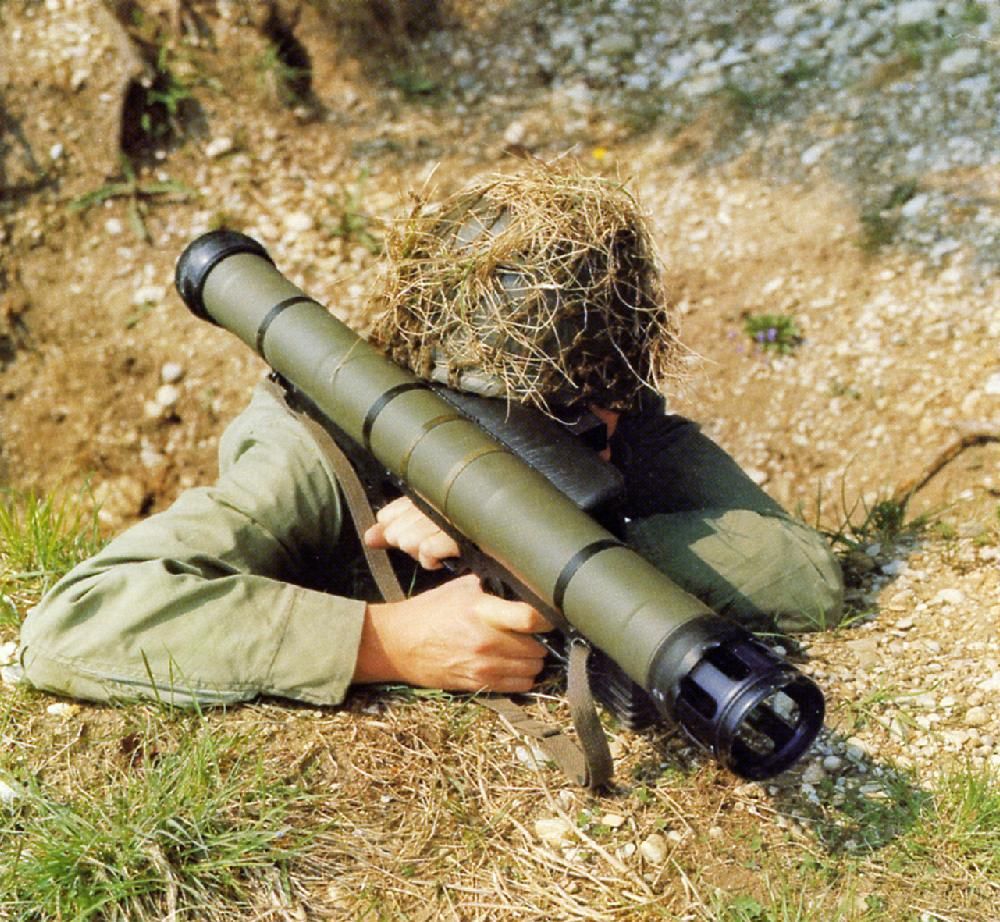
An Armbrust launcher | |
| Type | Recoilless gun |
| Place of origin | West Germany |
| Service history | |
| Used by | See Operators |
| Wars | |
| Production history | |
| Designer | Messerschmitt-Bölkow-Blohm (MBB) |
| Manufacturer | Messerschmitt-Bölkow-Blohm (MBB) Pouderies Réunies de Belgique (PRB) ST Kinetics (STK) |
| Variants | Armbrust AT, Armbrust AP, Armbrust Ub, Armbrust SC |
| Specifications | |
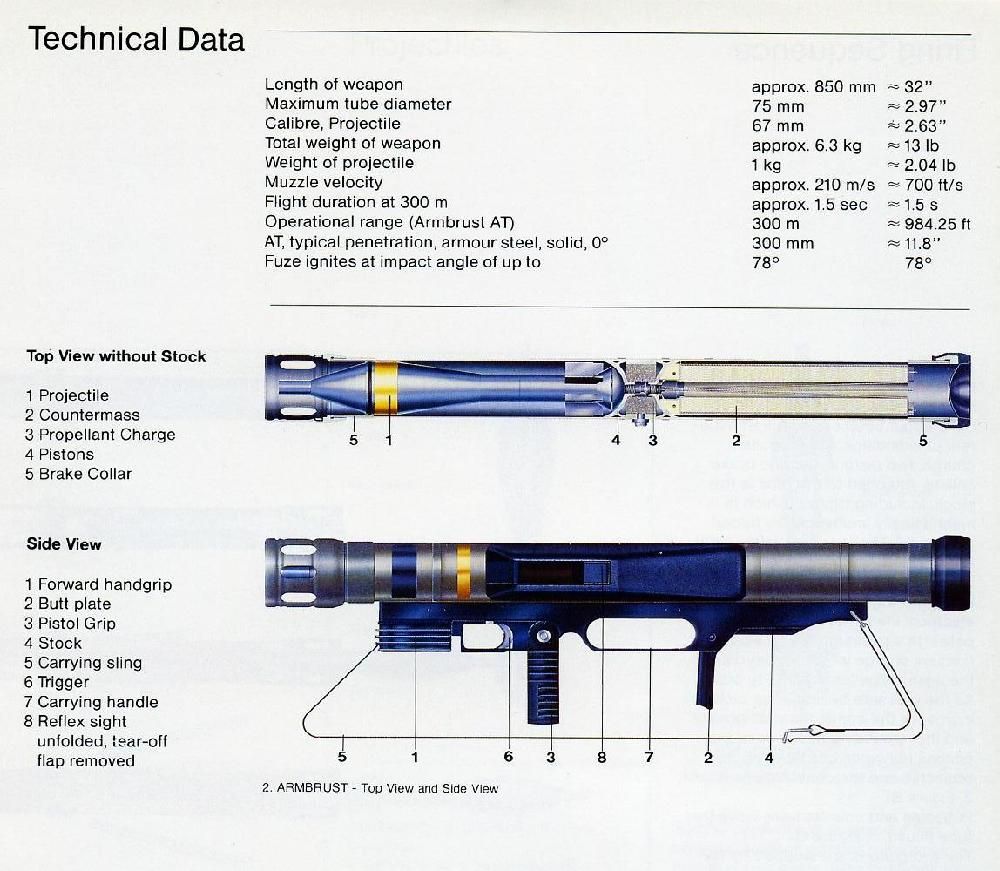
| Mass | 6.3 kg (13 lb 14 oz) |
| Length | 850 mm (2 ft 9 in) |
| Width | 126 mm (5.0 in) |
| Height | 140 mm (5.5 in) |
| Caliber | 67 mm (2.6 in) |
| Action | Recoilless weapon |
| Muzzle velocity | 210 m/s (690 ft/s) |
| Effective firing range | 300 m (980 ft) |
| Maximum firing range | 1,500 m (4,900 ft) |
| Feed system | Single shot |
| Sights | Reticle, externally illuminated for night |
Armbrust (German: Crossbow) is a lightweight unguided anti-tank weapon designed and developed by Messerschmitt-Bölkow-Blohm of Germany, who later sold its manufacturing rights to Chartered Industries of Singapore (the predecessor of ST Kinetics).
Overview
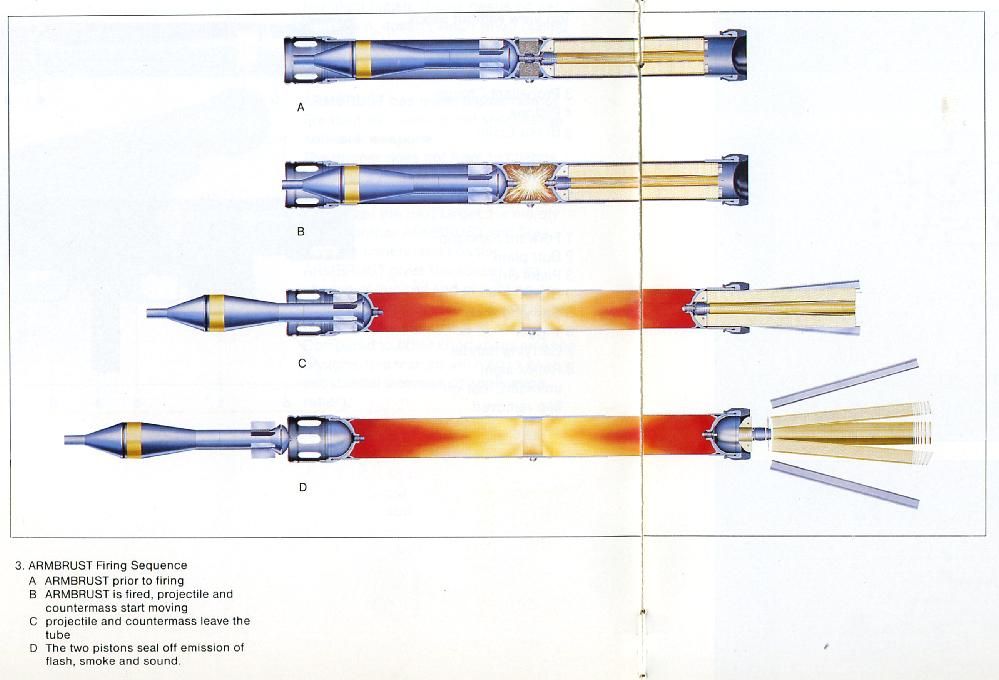
The Armbrust is a recoilless weapon, and is one of the few weapons of this kind that may safely be fired in an enclosed space. The propellant charge is placed between two pistons with the projectile in front of one and a mass of shredded plastic in the rear. Unlike most recoilless weapons, it is a true counter-shot weapon, as the mass of the projectile is equal to the mass of the counterweight and they are ejected from the barrel at the same initial velocity. When the weapon is fired, the propellant expands, pushing the two pistons out. The projectile is forced out of the front and the plastic out of the back. The plastic disperses on leaving the back of the barrel, and is quickly stopped by air resistance. The pistons jam at either end of the barrel, locking the hot gases inside. Its warhead can penetrate up to 300 mm of steel armor.[1]
Since 2004, Armbrusts have gradually been replaced by the Israeli-German-Singapore co-developed MATADOR.[2]
Combat use
During the Cambodian–Vietnamese War, Armbrust was supplied to the Cambodian Khmer Rouge. It was used in their fight against the Cambodian government, as well as against Vietnamese Army.[3][4] Cuban troops in Angola captured several Armbrust launchers from UNITA during the late 1980s.[5]
In the early 1990s, Slovenian and Croatian forces obtained a number of Armbrusts and used them against the Yugoslav People's Army (JNA) armoured vehicles during the Yugoslav Wars in 1991. While the Armbrust couldn't defeat the frontal armour of the M-84 tank, it could penetrate the thinner sides and rear. It was also used to destroy armoured personnel carriers of the JNA, such as the M-60 and BOV.[6][7] In 1998, the Kosovo Liberation Army smuggled a small number of rockets from the border with Albania, using them against Serbian tanks and armoured fighting vehicles.[8][9]
Operators
| External images | |
|---|---|
| Armbrust 1980s brochure photos | |
| Soldier firing Armbrust | |
| Details of Armbrust and cut-away drawing | |
| Details of firing of Armbrust low launch signature | |
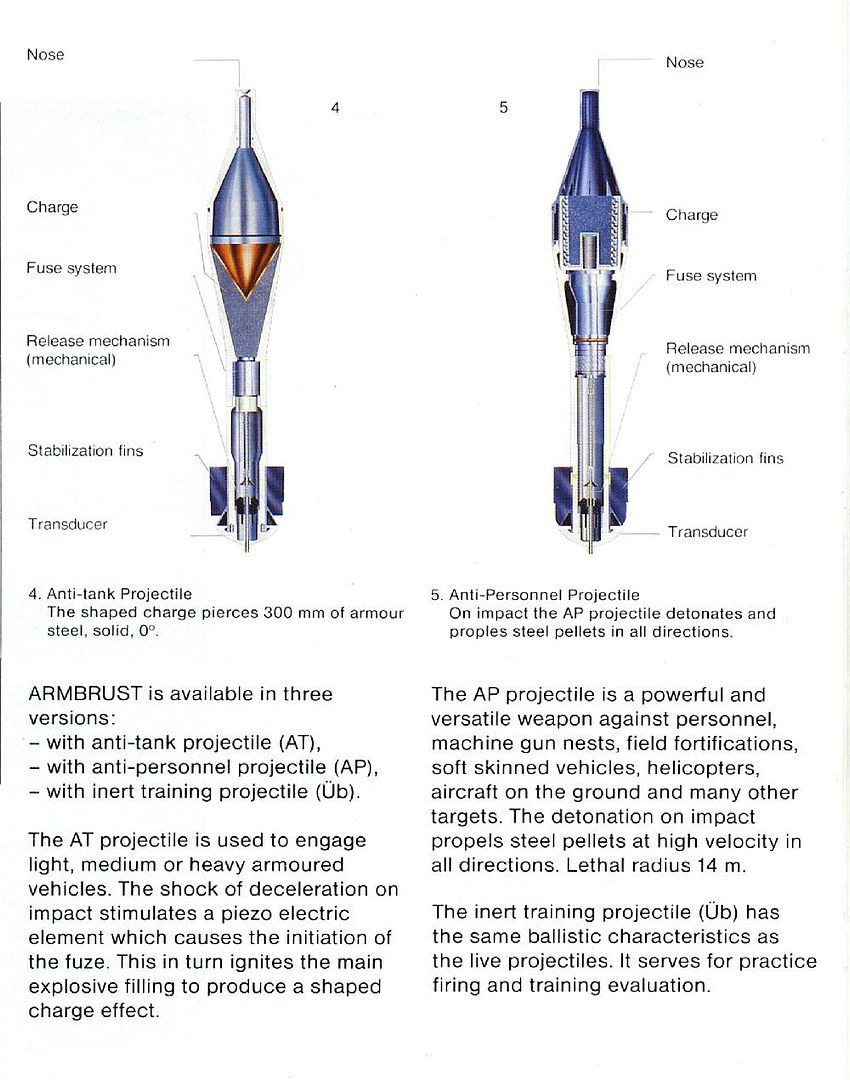
| Details of Armbrust anti-armour and anti-personnel projectiles |
Current
- Brunei[10]
- Cambodia[10]
- Chile[10]
- Indonesia – Komando Pasukan Katak (Kopaska) tactical diver group and Komando Pasukan Khusus (Kopassus) special forces group.[11]
- Philippines – Philippine Army, Philippine Marine Corps, Presidential Security Group[12]
- Singapore[10]
- Slovenia[10] − First used during the Ten-Day War[13]
- Thailand
Former
- Croatia – Used during the Croatian War of Independence[6]
- Kosovo Liberation Army − Used during the Kosovo War[8][9]
See also
- PzF 44 – (West Germany)
- Panzerfaust 3 – (West Germany)
References
- ^ Jane's Infantry Weapons 1995-96, page 318, edited by T. Gander and I. Hogg, ISBN 0-7106-1241-9
- ^ "Factsheet - MATADOR: Unguided Short Range Anti-Armour Weapon (SRAAW)" (Press release). Singaporean Ministry of Defence (MINDEF). 15 June 2005. Archived from the original on 22 October 2007. Retrieved 16 June 2011.
- ^ New Straits Times: Khmer Rouge using Missiles made in West, March, 12. 1994
- ^ Die Zeit, Michael Sontheimer: Die Mörder kehren zurück, January, 12. 1990 (German)
- ^ Furlong, Robert D.M. (Feb 1, 1990). "US anti-tank missile developments". Armada International.
- ^ a b Zaloga, Steven J. (2013). T-72 Main Battle Tank 1974–93. New Vanguard (PDF ed.). Oxford, UK: Osprey. p. 41. ISBN 978-1-4728-0555-3 – via Google Books.
- ^ Balkan Battlegrounds: A Military History of the Yugoslav Conflict, 1990–1995. Vol. 1. Washington, DC: Central Intelligence Agency, Office of Russian and European Analysis. 2002. p. 66 – via Google Books.
- ^ a b Hedges, Chris (11 July 1998). "With Better Arms, Kosovo Separatists Turn Tide in War". The New York Times. Archived from the original on 27 May 2015. Retrieved 13 January 2026.
- ^ a b Smith, R. Jeffrey (22 July 1998). "Kosovo Rebels Stumble as Gambit Backfires". The Washington Post. Archived from the original on 27 August 2017. Retrieved 13 January 2026.
- ^ a b c d e Jones, Richard D. Jane's Infantry Weapons 2009/2010. Jane's Information Group; 35 edition (January 27, 2009). ISBN 978-0-7106-2869-5.
- ^ "Kopassus & Kopaska - Specijalne Postrojbe Republike Indonezije" (in Croatian). Hrvatski Vojnik Magazine. Archived from the original on 2010-08-22. Retrieved 2010-06-12.
- ^ "Armbrust in the AFP". Archived from the original on 6 January 2014. Retrieved 6 June 2012.
- ^ Micheletti, Eric (1992). "War in Slovenia". The Balkans at War: Yugoslavia Divided 1991. Tsuen Wan, Hong Kong: Concord Publications. pp. 22, 24. ISBN 978-962-361-910-3.